
- The Robot have different mechanisms and the use of pneumatic cylinder (Pneumatic cylinder-Wikipedia) is most common in robotics mechanisms.
- Pneumatic Cylinder is also used in many automation systems.
- In this post I am going to explain how we can calculate the volume of pressurize air required to operate 'n' pneumatic cylinder strokes.
- Similarly we can calculate the operated strokes('n') with pressurizes volume of 'V' between the certain pressure limit.
- Here the difficult part is that the pressure range is fixed. So if initial pressure is 6 bar (1 bar = 100000 Pascal) then we have to calculate the strokes of pneumatic can filled just before the pressure reaches 4 bar.
- If the pressure limit goes below the certain limit the precise work can not be achieved, OR pneumatic cylinder can't give the required amount of force.
Before going to read this calculations you must have some primary knowledge of Pressure,Force and Area relationship.
Before going to read this calculations you must have some primary knowledge of Pressure,Force and Area relationship.
- Explanation:
Let we take an Example for easy understanding.
If we consider a Tank of volume 'V' filled with pressurized Air. Let we take the initial pressure of Tank is Pi=6 bar. We can operate our pneumatic cylinder up-to final pressure Pf=4 bar.
If the pressure goes below 4 bar the
pneumatic can't work properly
in our case.
So we can set the compressor at
auto-start at 4 bar.
If tank refilling is not possible
in certain tasks
(Like Robocon Competition)
we have to put enough volume
of pressurized air with our robot.
we want to set the relationship between the volume of compressed air 'V' ,
initial pressure 'Pi' ,Final pressure 'Pf'
and the number of strokes operated 'n' within this pressure limit.
let's try to sole this problem by equation and laws of thermodynamics.
Let we assume that the process is Adiabatic.(Adiabatic Process-Wikipedia).
In this process the flow of air fills the cylinder rapidly so we can assume this is adiabatic process.
For easy understanding of this explanation let we take single acting Cylinder.
The volume of cylinder is ‘v’.
The volume of cylinder is equal to piston area times the length of Stroke.
 |
| A typical Compressor that can be used to operate pneumatic cylinders. |
If the pressure goes below 4 bar the
pneumatic can't work properly
in our case.
So we can set the compressor at
auto-start at 4 bar.
If tank refilling is not possible
in certain tasks
(Like Robocon Competition)
we have to put enough volume
of pressurized air with our robot.
we want to set the relationship between the volume of compressed air 'V' ,
initial pressure 'Pi' ,Final pressure 'Pf'
and the number of strokes operated 'n' within this pressure limit.
let's try to sole this problem by equation and laws of thermodynamics.
Let we assume that the process is Adiabatic.(Adiabatic Process-Wikipedia).
In this process the flow of air fills the cylinder rapidly so we can assume this is adiabatic process.
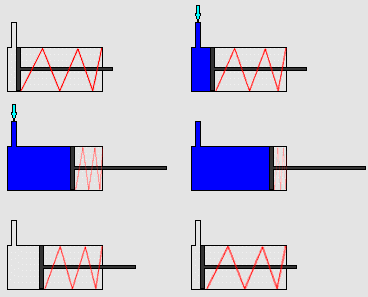 |
| Single acting Pneumatic Cylinder operational diagram |
For easy understanding of this explanation let we take single acting Cylinder.
The volume of cylinder is ‘v’.
The volume of cylinder is equal to piston area times the length of Stroke.

 |
| Double acting Pneumatic Cylinder operational diagram |
For initial condition:
Pressure = Pi
Volume = V
final condition:
Pressure = Pf
Volume = V+nv
For the adiabatic process:

By Using this Equation We can Make Predictions.
Pf=Final pressure of Tank
V=tank volume
n=Number of stokes operated
v=volume of cylinder
𝜸 = 1.4 For Air
The value calculated by this equation is not 100% accurate, because at the final stage the total volume is not at the same pressure 'Pf' and the process is not truly adiabatic. So we have to use more complicated equation and calculation, Although we can use this equation for making a good prediction.
We have done some practicals to see how much strokes can be filled. we found that the actual filled strokes is more than 90% of calculated value.
The value calculated by this equation is not 100% accurate, because at the final stage the total volume is not at the same pressure 'Pf' and the process is not truly adiabatic. So we have to use more complicated equation and calculation, Although we can use this equation for making a good prediction.
We have done some practicals to see how much strokes can be filled. we found that the actual filled strokes is more than 90% of calculated value.
Experimental Results:
we take a 2.5 Liters coca cola bottle, make it air tight with M-seal. Filled it Up to 6 bar gauge Pressure.
Pi= 6 bar = 6,00,000 Pascals
Pf= 4 bar = 4,00,000 Pascals
V= 2.5 Liters = 2.5*10^(-3) m^3
n=Number of stokes operated
𝜸 = 1.4 For Air
Piston Dia=25 mm, Stroke length=40 cm
v=1.9635*10^(-4) m^3

From above Equation We get
n = 4.28

